
What Taylor County Deed Records Show
The Register of Deeds records far more than deeds. Mortgages, trusts, easements, and land contracts sit in the same Taylor County collection. A typical deed entry lists the grantor, the grantee, a document type, a recording reference, and a legal description. That entry is only a summary. The recorded image carries the full instrument and its clauses. A parcel card can point you toward the right deed, but the deed and its recorded chain supply the actual title evidence for Taylor County real estate.
| Instrument family | What the record may document | Search clue |
|---|---|---|
| Warranty or quitclaim deed | A transfer and the parties named | Grantor, grantee, legal description |
| Mortgage or satisfaction | A real-estate security interest or release | Borrower, lender, later release |
| Easement or restriction | A recorded right or limit affecting land | Parcel description and parties |
| Trust or personal representative deed | A transfer through an entity or estate | Trust, estate, or representative name |
| Plat or certified survey map | Lots and recorded land divisions | Plat name, lot, block, instrument |
Take each instrument at face value. An index entry is not a legal opinion. A deed alone will not reveal later tax payments or every possible lien against the land. When a mortgage matters, hunt for a recorded satisfaction or release instead of assuming it was paid.
LandShark's Taylor County Index and Its Reach
Taylor County offers online real-estate records through LandShark from April 1995 forward. That date is not the start of county recordkeeping. It simply marks where the internet index begins. Earlier transactions live at the Register of Deeds counter, in bound books, grantor-grantee indexes, scans, and microfilm. The office makes those older formats available on request.
LandShark pairs a quick party search with an advanced search by legal description. County guidance suggests using both. Run each name in both roles, since a current grantee may show up later as a grantor. Vary spellings, middle initials, suffixes, and business forms. The county also warns that recording does not require a parcel ID, so a parcel-only query can miss a deed.
Searching is free. Image access for occasional users follows the page fee schedule, and frequent users can pick a monthly option. Find the record first. Note its number or book-and-page reference. Each route leads to the same recorded document. Then decide whether to open the image online or request a copy from the office.
Read Both Sides of a Taylor County Conveyance
Grantor and grantee form the basic trail through Taylor County deed records. The grantor conveys the interest. The grantee receives it. Search the current owner as grantee to locate the acquisition deed, then note the prior grantor named in it. Search that prior grantor as a grantee further back. Repeat that step while the legal description still matches, which separates a same-name hit from a transaction involving the same land.
Names alone will not carry the search. Compare the legal description, the municipality, the recording date, and the instrument reference. Trusts, estates, and LLCs appear where you might expect a person. So do changed spellings and stray middle initials. Log both parties and the land description for every instrument you open.
| Grantor | Party shown as conveying an interest |
|---|---|
| Grantee | Party shown as receiving an interest |
| Legal description | Land text used to test whether two entries concern the same parcel |
| Recording reference | Index key for the county's filed instrument |
Find Taylor County Documents by Name and Land Description
A parcel number may be missing from the record, so the broad Taylor County path uses several keys. Start with the address or parcel card to learn the owner's name and legal description. In LandShark, run the person or business as both grantor and grantee. Then plug the legal description into advanced search, adding any other details the instrument offers. Name-only searches get noisy, especially with a common name.
The county's free Land Notification service suggests searching a person or business several ways, with parcel information as a second route. A matching alert only hints at possible activity. Open the linked item. Confirm its parties and legal description. The service cannot certify title or judge a recording's legitimacy, so treat each alert as a prompt to verify the instrument with the Register of Deeds.
The county's Land Notification service page explains the monitoring. It covers both name and parcel watching. Matches send you back to the official county record system.
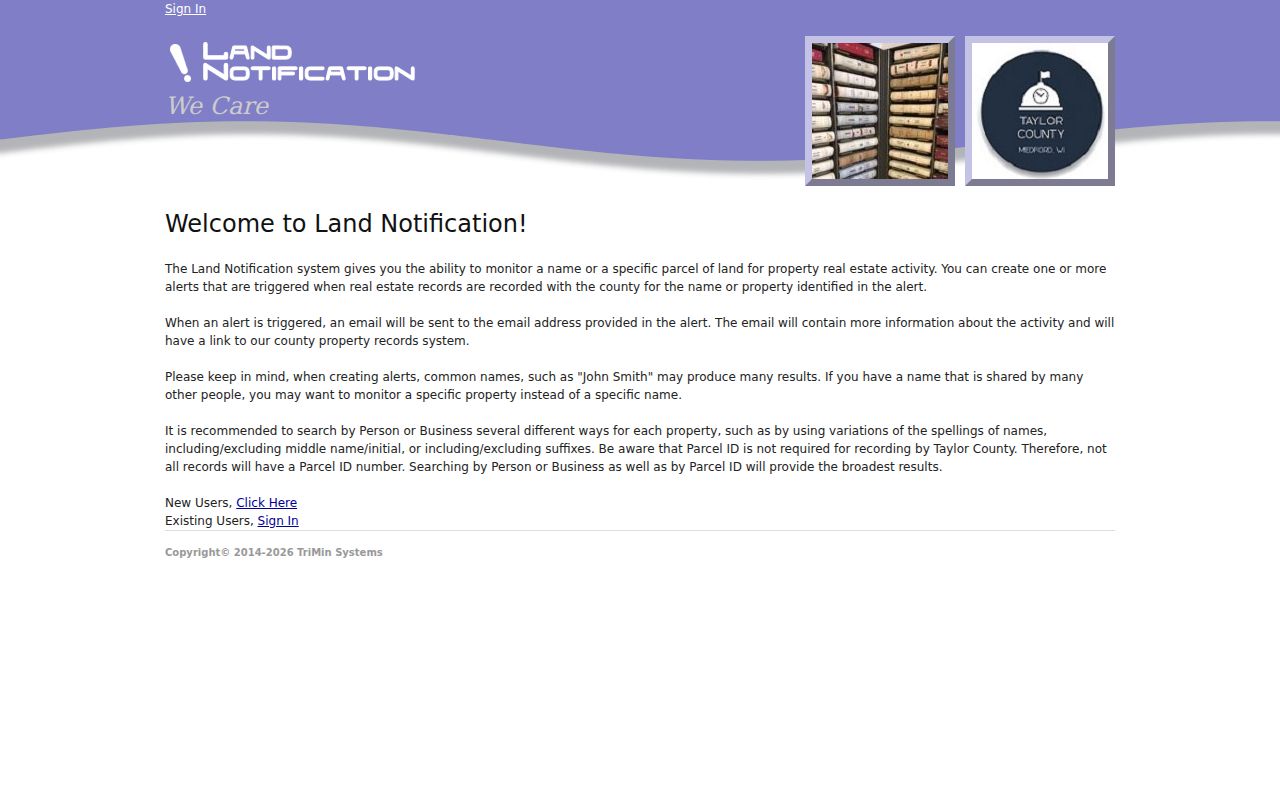
An alert is only a prompt. Open the filed document, then confirm the instrument with the Register of Deeds.
Copy and Recording Costs at the Taylor County ROD
Recording at the Taylor County Register of Deeds costs $30 flat per document, plats excepted. Plain copies run $2 for the first page. Each added page is $1. Certification tacks on another $1 per copy. Under the county land-information plan, the in-house indexes and images are open to the public at no charge, while occasional users pulling images online pay the statutory page schedule. Searching, viewing, recording, and certifying are separate costs, so it helps to know which service you need before requesting anything from the deed records office.
Documents are accepted weekdays from 8:30 a.m. to 3:30 p.m. Central. Recording stops at 11 a.m. on Good Friday. A mailed deed should include a self-addressed stamped envelope. Without one, the original has to be picked up within 60 days, or a SASE sent later, and the county warns that unclaimed originals may be shredded after that window. A call to 715-748-1483 before a special trip or mailing can save a wasted effort.
Send a Taylor County Recording With a Return Envelope
The envelope rule trips up plenty of filers. Taylor County returns a recorded original by mail only in one case. A self-addressed stamped envelope must come with the deed. Skip it and the original must be collected within 60 days. An envelope can also be sent after the fact. Anything still unclaimed at that point may be shredded, the county cautions. Before mailing legal papers, confirm current instructions with the Register of Deeds directly.
You will find the office on the second floor of the courthouse. The address is 224 South Second Street in Medford. Recording hours run 8:30 a.m. to 3:30 p.m. Central on weekdays, with the early Good Friday closing. When ordering copies from the deed records, say whether an ordinary copy or a certified copy is wanted. The two are distinct, and a certified page carries its own fee beyond the per-page charges.
Older Taylor County Deeds Require a Courthouse Route
Transfers older than LandShark's documented April 1995 online reach call for a different route. Contact the Taylor County Register of Deeds. Ask which volumes or indexes cover the period in question. The ROD's genealogy policy permits weekday research with no appointment, though the vault rules are strict: phones, cameras, computers, pens, purses, and bags are all barred. Staff will point you to the right books. The search itself remains yours to do.
Older addresses and neighborhood names can be pinned down with the Wisconsin Historical Society's 1913 Medford Sanborn map. Its newspaper guide helps too. These are context, not deed substitutes. The Taylor County Leader published from 1883 to 1929. It included a Waldbote title variation and German-language issues through 1919. Let a newspaper clue sharpen the name or place. Then take it back to the ROD records for proof of ownership.
For a step-by-step chain of prior owners, continue to the Taylor County former-owner guide.
Mortgages, Easements, and Taylor County Title Questions
Mortgages, easements, trusts, and other real-estate instruments sit in the deed records alongside conveyances. A Taylor County deed search is really one slice of a longer instrument trail. Look for the mortgage. Then hunt down its later satisfaction or release. Where access or a lot's relation to nearby land is at issue, pull the easement, restriction, or recorded plat too.
Judgments and liens add another wrinkle. WCCA can point to a public case. But it is not the official county judgment and lien docket; that record belongs to the Clerk of Circuit Court. A full title inquiry may draw on the deed index, recorded instruments, the court docket, and tax information together. One search result never proves that every encumbrance has surfaced.
What Taylor County Deed Records Cannot Decide Alone
A recorded deed proves the instrument was filed and supplies its legal text. It cannot settle whether a boundary tracks a fence. It also cannot settle whether a later release sits outside the search range, or whether the parcel roll reflects a recent transaction yet. Indexes can drop a parcel number. Online images can miss context held in other filings. So read the whole document and weigh its description against the earlier chain of title.
Verify the land and the parties. Taylor County deed records are a public source, but an index search is not a title opinion. Ask the Register of Deeds for the filed image, a title professional for a title question, and a licensed surveyor for a boundary question.