
What Taylor County Property Tax Records Contain
Taylor County splits its property tax records in two. Assessment data sits on one side, the bill itself on the other. The Real Property Lister and Land Information maintain the computerized assessment and tax rolls. The Treasurer links tax-bill lookup and payment services. Portal labels vary. Treat any field list as a guide to what these Taylor County records commonly include, from parcel number and owner to tax year, charges, credits, and payment status.
| Record or value | What it means | County office |
|---|---|---|
| Land value | Assessment assigned to the land portion | Land Information / RPL |
| Improvement value | Assessment assigned to improvements, if shown | Land Information / RPL |
| Total assessed value | Roll value used in the assessment record | Land Information / RPL |
| Tax district and year | Context for the bill and levy | Tax roll / Treasurer |
| Amount due or paid | Bill status and payment history | Treasurer |
| Tax-deed file | County process involving delinquent land | Treasurer |
Assessed value is not a sale price. An owner field is not proof either. When the question is what the numbers mean, start with the assessor record. For a due amount or a tax-deed question, the Treasurer's record decides it.
Open Taylor County's Guest Tax Parcel Portal
Taylor County offers a public guest route into its tax parcel data. The sign-in page shows the terms first. Guest Sign In sits beside a staff login. Accept the terms to view parcels. The county's own disclaimer calls the data general land-related information, not detailed site-specific analysis, and makes no promise that every item is error-free.
Search by a known address or parcel key. Save the tax year and parcel number with your notes. For the bill itself, the Treasurer's department page links Tax Bill Lookup and Tax Payments. Use that route for balance and payment status. A delinquency or tax-deed question needs a case-specific answer, so contact the Treasurer directly.
The Taylor County guest portal opens with its terms and sign-in choices. That official page is the safest starting point.
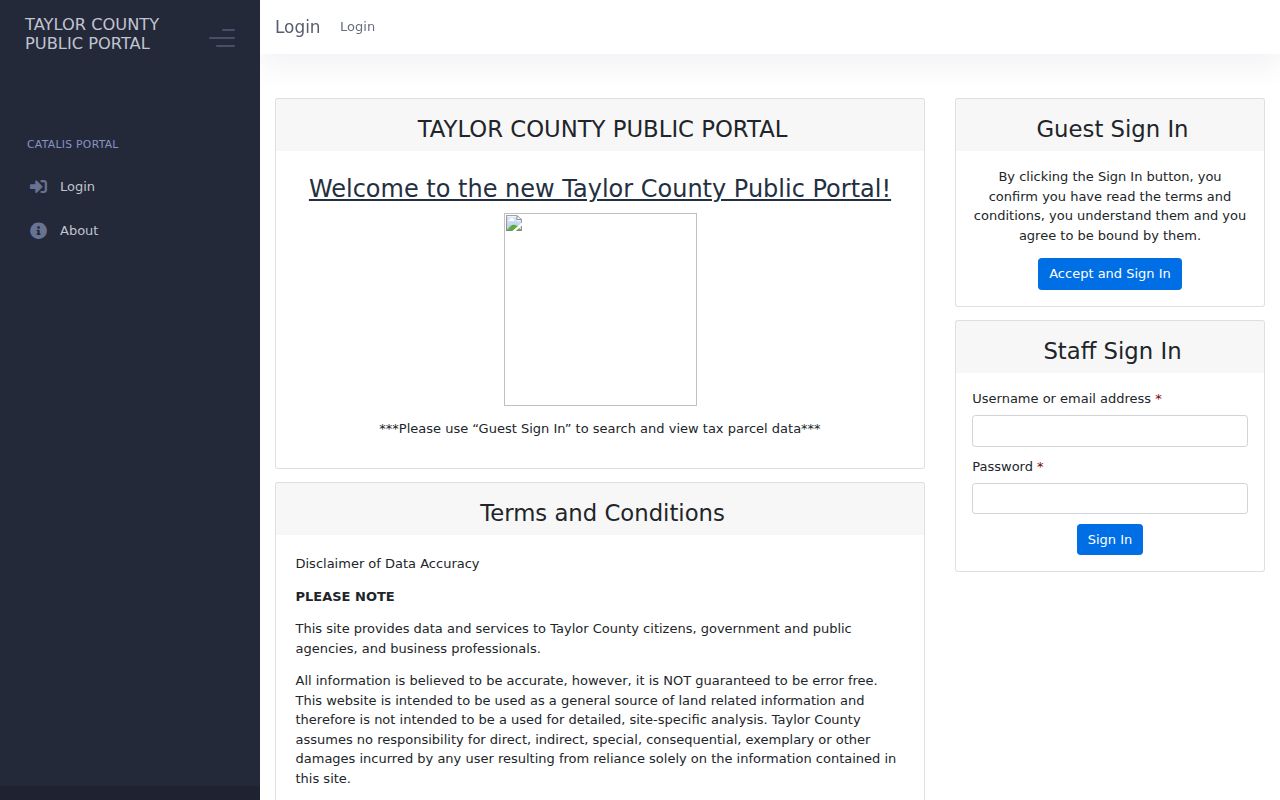
Guest access opens the parcel data. Payment questions, though, belong with the Treasurer's linked bill service.
Separate Taylor County Assessment Values From the Bill
A Taylor County parcel record may show land, improvement, and total assessed values. Those figures belong to the assessment record. A tax bill is different. It reflects the charges and credits for a given tax year and district, along with payment status. The county posts no universal assessment ratio, and no tax-roll refresh schedule is published either. Trust neither a parcel card nor another Wisconsin county here.
When checking a roll entry against a deed or recent sale, record the value year and the deed date separately. A transfer price is a past transaction amount. An assessed value is an administrative valuation. A market estimate is a third question. Use the property tax records page to locate assessment and bill data, and leave value disputes to the assessment record and the recorded sale documents.
- Assessed value
- Value entered on the local assessment roll.
- Tax bill
- Charges and credits assigned for a tax year.
- Tax district
- The local taxing context shown with a parcel or bill.
- Payment status
- The Treasurer's record of amounts paid, due, or delinquent.
The Treasurer's Taylor County Bill and Tax-Deed Records
The Taylor County Treasurer sends out tax bills, takes payments, tracks delinquent taxes, and handles tax deeds. The department page links both Tax Bill Lookup and Tax Payments, and it notes the Treasurer's duty over tax-deed property sales. Suspect a parcel is delinquent? Start with the tax lookup. Then ask the Treasurer about the balance, the sale, or the file. A tax card or map is not a payment receipt.
The live bill page shows its own fields. Look for parcel and year, billed owner, situs and mailing address, gross charge, credits, installment details, payment date, balance, and any delinquent amount. If ownership shifts near a tax-deed event, compare the newest deed in LandShark. The Treasurer answers collection status. The Register of Deeds confirms which instrument was recorded.
Reach the Taylor County Treasurer at 715-748-1466, or use the Treasurer's page for bill and payment links.
Requesting a Taylor County Assessment Export
Land Information maintains the county's assessment and tax rolls, and bulk exports cost money. The land-information plan sets a data-export charge of $300 plus $30 for personnel time. Partial data dumps are prorated up to $300. GIS layers follow a different rule. Anyone can receive layers at no cost under a data-use agreement. Government agencies get them without charge. An export and a layer are not the same request.
For a property-specific question, start in the guest portal. The Real Property Lister can supply a copy or clarification. For a broader roll export, spell out the fields and date range you need. Ask how the fee gets estimated. Wisconsin's Public Records Law requires a reasonable description of existing records. But it does not force the county to build a new analysis from separate data. Land Information is listed at 715-748-1465.
Medford's Separate Assessment Review Calendar
Medford runs its own assessment calendar alongside Taylor County's tax and GIS system. The city assessor page names Accurate Assessor as its contractor. It lists Open Book for June 18, 2026, from 9 to 11. Board of Review follows on July 7, 2026, from 6 to 8, with objection forms available. Those dates have passed. Check the city page or contact the assessor for the next calendar. Do not assume the same dates repeat each year.
The Accurate Assessor search link does not load. That makes the county parcel portal the practical starting point for the roll. Also remember the city calendar is not a countywide appeal deadline. Taylor County publishes no countywide assessment ratio. It posts no local exemption list and no single appeal window covering every parcel. Ask the applicable assessor for the current notice, the filing steps, and the evidence standard. Keep that review process separate from the Treasurer's bill payment.
When a Taylor County Tax Card and Deed Differ
A recent sale can reach the Register of Deeds first. The roll may still show the old owner. Taylor County publishes no fixed post-closing update interval. A parcel card and the deed index sometimes differ. Pull the latest recorded conveyance along with its legal description. Then ask Land Information whether the roll entry has been updated. Never assume a standard number of days for the county's refresh cycle.
Other mismatches have mundane causes. Mailing addresses often fail to match a street search. So do entity names, estates, and legal descriptions. The tax roll is an administrative record, not final title evidence. A deed, in turn, does not show whether a tax bill has been paid. Route each question to the custodian responsible for it. Keep the tax year, the recording date, and the parcel number in your notes.
Assessment Review and Taylor County Tax Record Limits
Assessment questions start with the value field and the year on the roll. A challenge is separate from finding a bill. It is separate from paying a balance. It is also separate from viewing a recorded deed. Ask the assessor about the meeting or form that applies to the parcel. Ask what evidence it accepts. Taylor County publishes no general exemption inventory and no appeal calendar covering every municipality. So no single calendar applies countywide.
Each value field has its own meaning. For assessed, market, and transfer values, see the Taylor County property value guide. For an amount due, go to the Treasurer. A map answers one question, a parcel card another, a bill a third. Do not blend them into a single value claim.
Check the right record. An assessed value is not a market appraisal, and a tax bill does not prove title. Confirm each value, payment, and transfer with the office that maintains that record.