
How to Find Who Owns a Taylor County Property
Start with a parcel. The county's public tax portal and Beacon both link an address to a parcel, and each also ties it to the name carried on the assessment roll. That name is a lead, not the final word. LandShark is the Register of Deeds search. It shows the recorded parties and the instrument behind each transfer. When the owner is an LLC or corporation, Wisconsin's Department of Financial Institutions can supply an entity record. That record never substitutes for the deed itself.
Keep four things together as you work: the property address, the owner name, the parcel number, and the legal description. Taylor County publishes no fixed closing-to-roll update interval. A fresh transfer may lag in the owner field. Until Land Information refreshes the roll, the newest recorded deed is the stronger evidence of when ownership changed.
- Search the property address in the county guest parcel portal.
- Copy the owner field, parcel number, municipality, and legal description.
- Search the name and legal description in LandShark as grantor and grantee.
- Use DFI for an entity name and ask the custodian about any unresolved gap.
Where Taylor County Owner Information Comes From
Several public sources can name an owner, and each answers a different question. The parcel roll is administrative. The recorded deed is the transfer instrument. The GIS map works as a spatial index. A business registry helps you identify an entity, but it cannot prove that entity owns the land in Taylor County. Match each source to the question it actually answers, and compare legal descriptions before concluding that two results describe one parcel.
| Source | Owner information | Access and limit |
|---|---|---|
| Taylor tax parcel portal | Owner field and mailing/situs clues | Guest access; general-data disclaimer |
| LandShark | Grantor and grantee on recorded instruments | Free index from April 1995 forward; images cost |
| Beacon GIS | Parcel position and advertised property details | Live fields not verified; map is not title |
| Wisconsin DFI | Business entity status and related filings | Entity record, not a deed |
Keep the Taylor County Situs and Mailing Fields Apart
Two addresses sit on most Taylor County parcel records, and they serve different purposes. The situs address locates the real estate itself. The mailing address tells the county where tax notices and other mail go. They diverge often. The causes vary widely. An out-of-county owner, a trust, an LLC, a PO box, or an agent can all do it. Remember that a mailing address never proves someone lives at the parcel. A tax roll name says nothing about who occupies the building.
Record both addresses exactly as displayed, keeping the municipality and ZIP in separate fields. A postal label alone does not settle the question. A Medford, Rib Lake, or Gilman label does not say whether a parcel sits inside a city or village boundary. The legal description and the municipal field resolve that question. When an address will not line up, the county's Uniform County Address System book can help bridge a changed or rural address. Its address-correction forms can help too.
When a Taylor County Owner Is an LLC or Trust
Not every Taylor County parcel lists a person's everyday name. The owner field may show an LLC, a corporation, a trust, or an estate. It may also list a personal representative. Search the exact entity spelling in LandShark and set it against the latest deed. Wisconsin DFI's Corporate Records Search adds an entity's status, registered agent, and principal office. It also covers the organization date and filings. Those details describe the entity record only. They do not reveal who benefits from a trust or prove ownership of the land.
Estate transfers raise another wrinkle. The deed may name a personal representative or beneficiary. A related probate case holds the order or inventory. The Register of Deeds records the land instrument. Taylor County court documents come from the Clerk of Court. Check the parcel legal description in both places. Do not treat a shared family name as proof.
Confirm the Taylor County Name in the Latest Deed
The Register of Deeds is where ownership gets confirmed. In LandShark, run the roll owner's name as grantee. Hunt for the newest matching conveyance. Read the grantor, grantee, recording date, and legal description right off the image. Then compare that land description with the parcel card. If the parcel number is missing, search by the parties and the legal text. Taylor County does not require a Parcel ID on every instrument.
A deed is often recorded before the assessment roll catches up. The county publishes no standard lag, so avoid estimating how many days an update takes. When names disagree, ask Land Information whether the roll has been refreshed. Treat the deed as the evidence of the recorded transfer. For more on the current owner field and its update caveats, see the Taylor County current owner guide.
Monitor Taylor County Recording Activity by Name
Land Notification is a free Taylor County service. It emails a link whenever a newly recorded instrument matches a name, business, or parcel you watch. The county suggests trying several spellings. It also suggests pairing a party name with a parcel clue where possible. Common names generate plenty of noise. Parcel-only monitoring, in turn, can miss an instrument recorded without a Parcel ID. Always read the matching document. Then decide what it means.
An alert certifies neither identity nor title. It simply points you back to the county record system. Compare every alert against the parcel's legal description and the parties named in the instrument. The Land Notification entry page describes the free monitoring service.
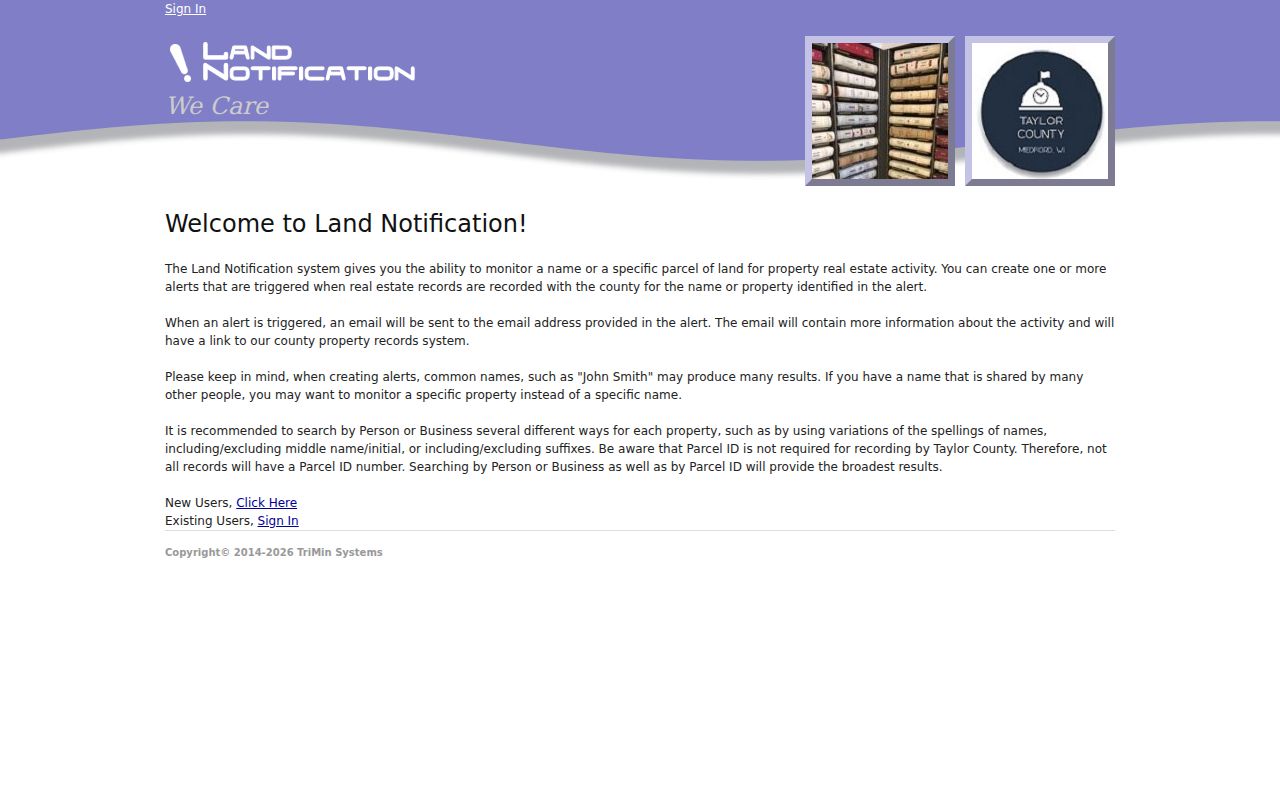
An alert is best treated as an early notice, not a verdict on ownership. When a name surfaces in Taylor County recording activity, pull the actual deed and read it before drawing any conclusion about who holds title.
Recent Taylor County Transfers Need Two Records
For a recent sale or estate transfer, pull two records at once. LandShark shows the recording trail. The tax parcel portal carries the owner name in the assessment system. The roll can still list the earlier owner until it updates. Taylor County publishes no exact post-closing schedule. A mismatch means you should compare dates and legal descriptions. It is not proof that either office erred.
Keep the deed's recording date separate from any sale or closing date the instrument states. Confirm the parcel record shows the same legal description. The online image may be closed to casual users. The Register of Deeds counter sells copies under its page charges. When the legal answer must cover every recorded interest, a title company can run the broader search.
Privacy and Limits of a Taylor County Owner Lookup
A recent sale or estate transfer calls for two documents in Taylor County. Pull the recorded deed and the parcel roll. The roll sometimes still lists the earlier owner of record. Taylor County publishes no fixed post-closing update schedule, so a lag alone means little. LandShark shows the recording trail. The tax parcel portal shows the owner name the assessor carries. When the two disagree, compare dates and legal descriptions before assuming an office slipped up.
Keep the deed's recording date distinct from any sale or closing date the instrument lists. Check that the parcel record repeats the same legal description. Casual users cannot always open the online image. They can order a copy at the Register of Deeds counter under its posted page charges. A legal answer covering every recorded interest may need more. A title company can run the broader search.
Use ownership records lawfully. A Taylor County owner lookup is not proof of occupancy or clear title. Do not use owner details to stalk, harass, intimidate, or harm anyone.